

 Shaikh Shahrukh

Despite major advances in lightning forecasting, Bangladesh continues to lose hundreds of lives each year because life-saving warnings often fail to reach those most at risk, exposing a critical weakness in the country’s disaster preparedness as it strives to meet the United Nations’ “Early Warnings for All” target by 2027.
As the world observed International Lightning Safety Day on Saturday under the theme “When Thunder Roars, Go Indoors,” disaster experts said Bangladesh’s challenge is no longer predicting dangerous storms but ensuring timely warnings reach farmers, fishermen and outdoor workers before lightning strikes.
According to the Department of Disaster Management (DDM), lightning has killed 3,860 people across Bangladesh over the past 12 years. The deadliest year was 2020, when 427 people lost their lives. As of June 14 this year, another 132 people had already died in lightning-related incidents.
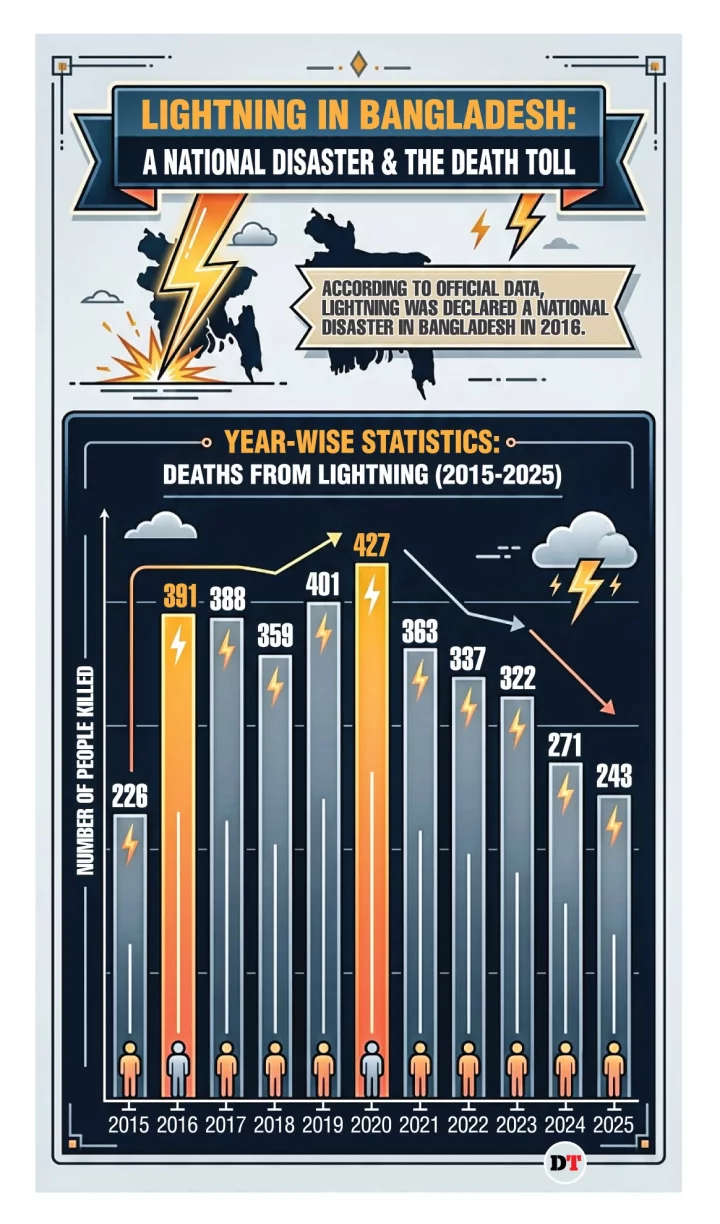
Bangladesh declared lightning a national disaster in 2016 following a sharp rise in fatalities. Some research organisations estimate the country has the highest lightning mortality rate per 1,000 square kilometres in South Asia and ranks second globally after India in annual lightning deaths.
The Bangladesh Meteorological Department (BMD) says it can now forecast lightning one to four hours before severe thunderstorms develop. But experts argue that the warning system breaks down at the “last mile” -- communicating those forecasts to people working in fields, rivers and other open areas.
Most lightning warnings are currently disseminated through television, websites and social media, leaving many farmers and fishermen without timely access as they often lack smartphones, internet connectivity or access to electronic media while at work.
Unlike many countries, Bangladesh has yet to introduce a nationwide cell broadcast-based emergency alert system capable of instantly sending warnings to every mobile phone within an affected area.
“The science is available, but the warning often does not reach the people who need it most,” said Rashim Molla, general secretary of the Save the Society and Thunderstorm Awareness Forum (SSTAF).
The communication gap echoes concerns raised under the UN-backed Early Warnings for All (EW4All) initiative, launched at COP27, which aims to ensure every person on Earth is protected by life-saving early warning systems by the end of 2027.
Meteorologists warn that climate change is making thunderstorms more frequent and intense across South Asia. At a recent BMD roundtable, meteorological expert Khan Md Golam Rabbani said Bangladesh is witnessing an increase in continuous-current lightning and positive lightning -- both among the most dangerous forms of lightning.
Senior meteorologist Bazlur Rashid said lightning is no longer confined to the traditional pre-monsoon season.
“Climate change is extending the lightning season into the monsoon months as warmer temperatures continue to generate severe convective storms,” he said.
Researchers from Buet have identified the northeastern haor region as Bangladesh’s principal lightning hotspot, with Jamalganj in Sunamganj, Sunamganj Sadar, Bishwamvarpur, Netrokona and parts of Moulvibazar facing the highest risk because thousands of farmers and fishermen work in open fields and wetlands with little immediate shelter.
Experts say Bangladesh now needs to shift its focus from forecasting alone to strengthening last-mile communication through technologies such as cell broadcast alerts, automated SMS, mosque loudspeakers, community sirens, volunteer networks and stronger coordination between the meteorological department and local administrations.
BMD Director Md Mominul Islam said forecasting capability has improved considerably over the years.
“We can now issue forecasts well in advance. The challenge is ensuring those warnings reach vulnerable communities quickly enough for people to take action,” he said.
Disaster specialists argue that unless warnings can reach people before lightning does, improved forecasting alone will not significantly reduce fatalities or help Bangladesh fulfil its commitments under the UN Early Warnings for All initiative and the Sendai Framework for Disaster Risk Reduction.